
Have you had the 2am thought? The one where you are lying there and it creeps in: is AI coming for my job? If you have, you are not alone, and you are not paranoid. I feel it too, and I talk to engineers every week who feel it. The job is changing fast, and pretending it is not would be silly.
Here is the part nobody says out loud, though. The engineer who is quietly panicking and the engineer who is about to become more valuable than ever are looking at the exact same technology. The only difference between them is one move. In this post I want to show you that move, the honest version, and then prove it works with a quick demo you can run yourself. Let's get into it.
The fear is rational. The "I'm done" conclusion is not.
I want to say the quiet thing clearly, because I think you need to hear it from another engineer and not from a scary headline. The fear is reasonable. I read comments every week from people who have been doing this for fifteen years, saying things like "I am a seasoned engineer and I am honestly not sure we are even needed anymore." That is not weakness. That is a smart person reading the room.
But the conclusion that so many people jump to, the "I am too late, I am done" conclusion, is wrong. And the reason it is wrong is hiding in plain sight. The skills you spent years getting good at, automation, infrastructure as code, GitOps, observability, are not disappearing. They are becoming the foundation that everything in AI gets built on top of. Your job is not dying. It is leveling up. Once you see it that way, the whole picture changes.
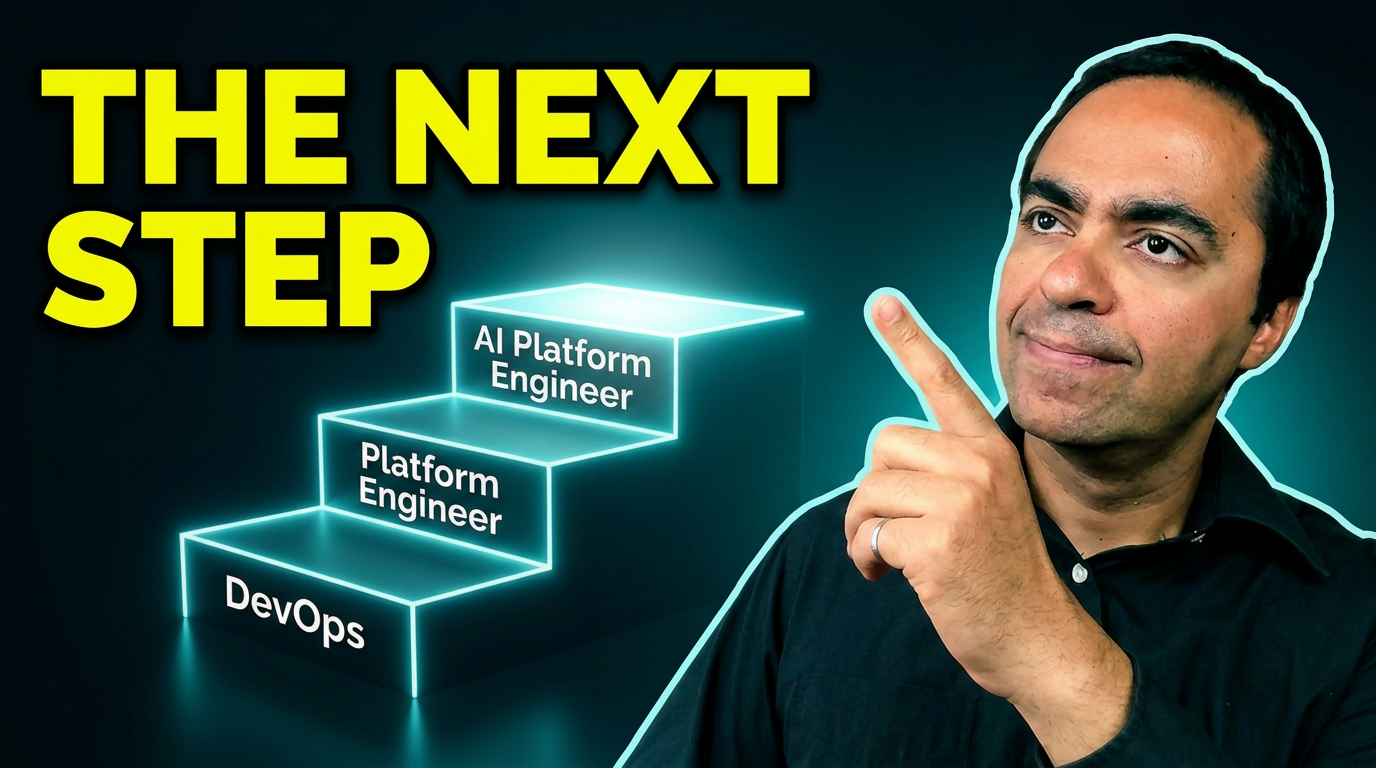
DevOps to Platform Engineer to AI Platform Engineer
Let me show you the path, because this is the heart of the whole thing.
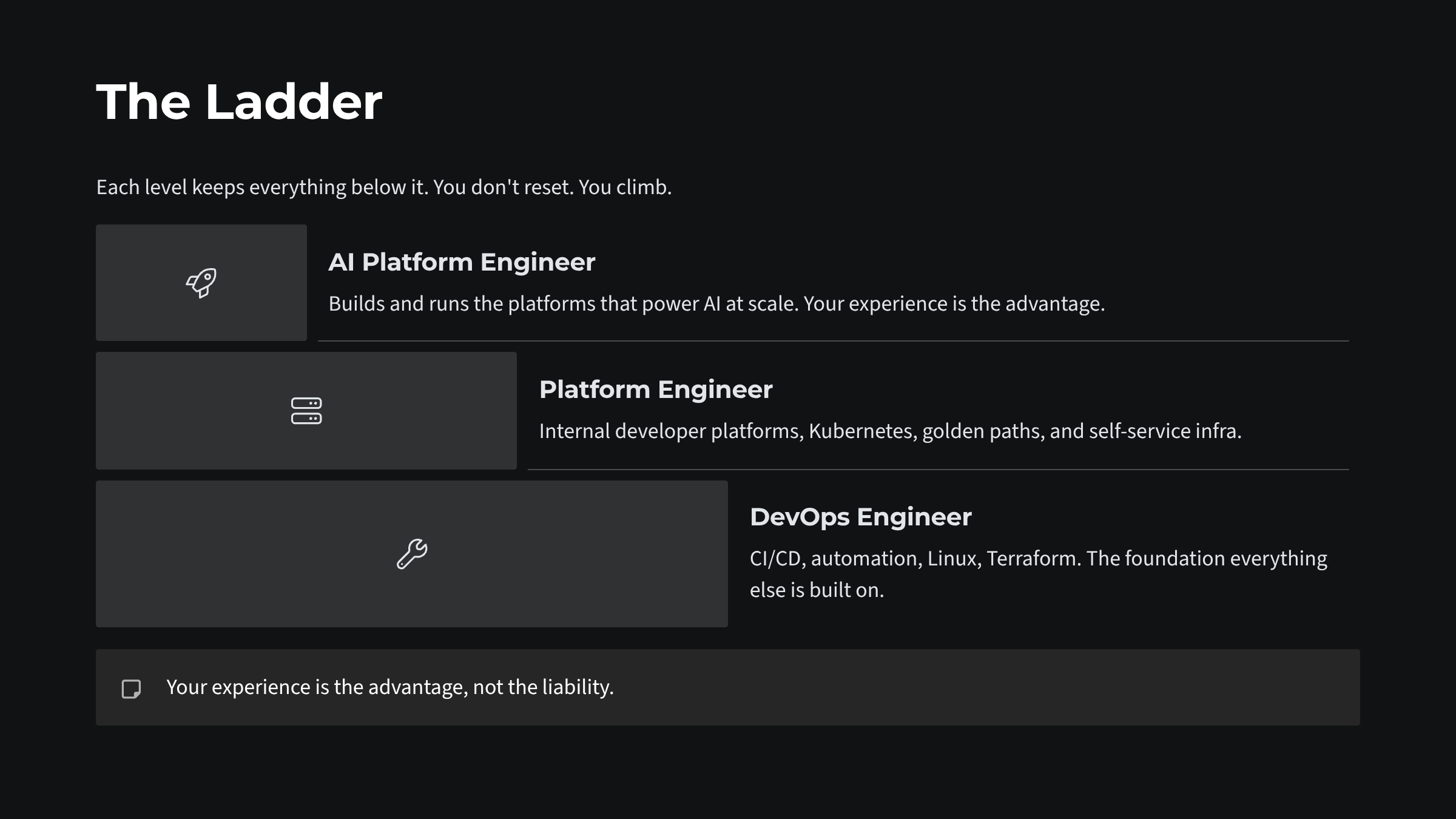
A DevOps engineer grows into a platform engineer by building the internal platforms that other teams build on. A platform engineer then grows into an AI Platform Engineer by learning to build and run the platforms that AI workloads need. Notice the most important detail in that picture: every level keeps everything below it. You do not reset to zero. You do not throw your experience in the trash and start over.
That is the part I really want you to sit with. The person starting from nothing is actually behind you here, not ahead of you, because the foundation is the part that takes years to earn. You already have it. You are not at the bottom of a new ladder. You are partway up one you have been climbing for a long time.
Why the AI Platform Engineer exists now
So why does this new level exist at all, and why now? The scary headlines have the mechanism completely backwards, and once you understand it you will stop worrying so much.
AI does not remove infrastructure work. It explodes it. Every team suddenly wants models, training pipelines, GPUs, vector databases, agents, and inference endpoints. That means more deployments, more cost, and more things that can break at 3am. All of that has to run somewhere, and somebody has to build and operate the platforms underneath it. That somebody is the AI Platform Engineer. AI is the thing that creates the work, not the thing that takes it away.
I do not want you to take my word for this, so let me give you a number that stopped me in my tracks. According to the State of AI in Platform Engineering research published by Luca Galante and the team at platformengineering.org, around 88 percent of companies are now running AI experiments, but only about 5.5 percent are getting real business value out of them. Read that again. Almost everyone is trying. Almost nobody is succeeding. And their conclusion is blunt: it is not a model problem, it is a platform problem. That gap is not a threat to you. That gap is your job description.
What an AI Platform Engineer actually does
Let's make this concrete, because "AI Platform Engineer" cannot just be a shiny new title on LinkedIn. The role comes down to three pillars, and I want you to notice what they all have in common.
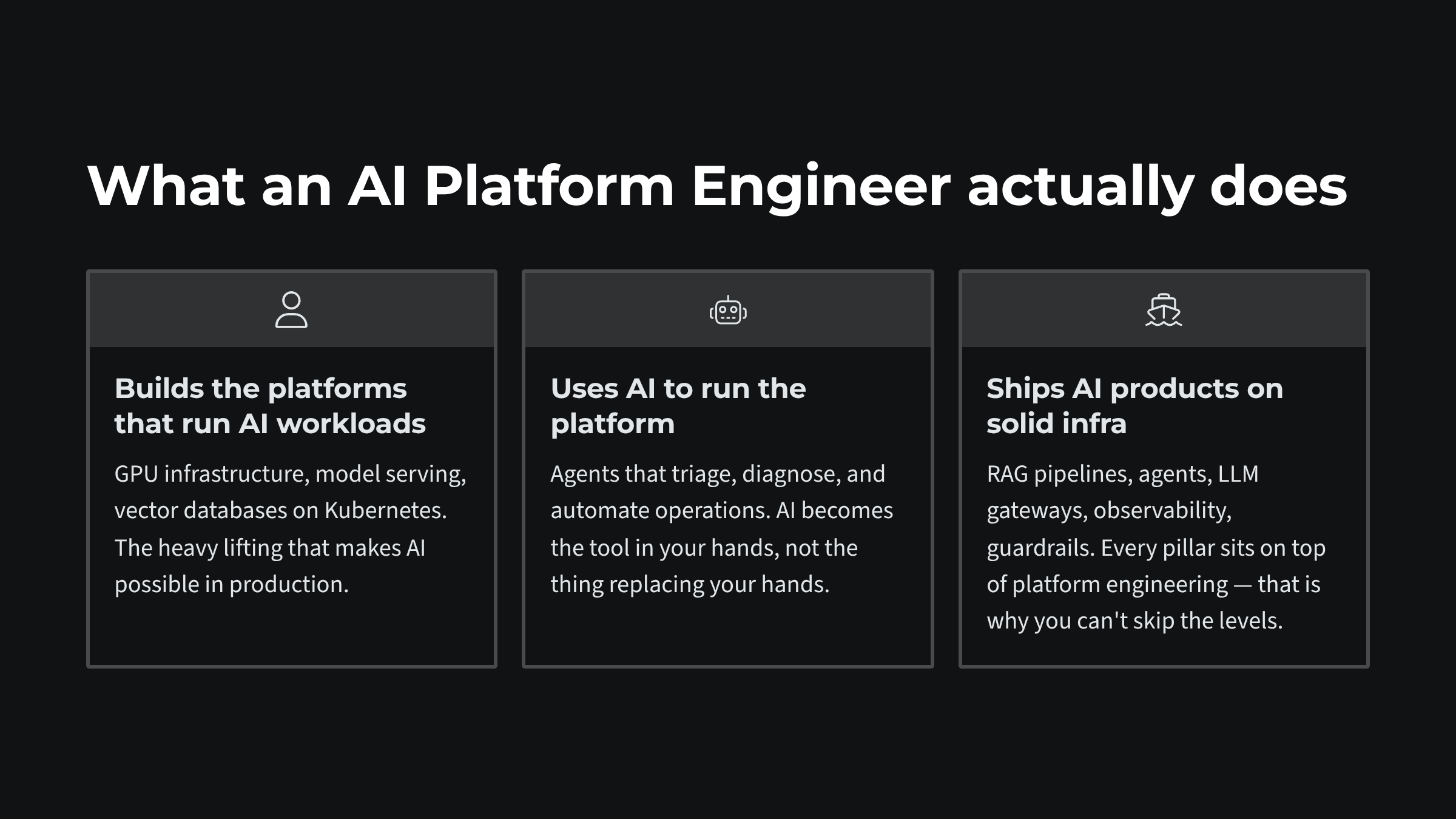
First, you build the platforms that run AI workloads: GPU infrastructure, model serving, and vector databases on Kubernetes, all production grade. Second, you use AI to run the platform itself: agents that triage alerts, diagnose failures, and automate the boring operational work so you move faster. Third, you ship AI products on solid infrastructure: RAG systems, agents, LLM gateways, observability, and the guardrails that make AI safe to put in front of real users.
Here is the thing I promised you would notice. Every single one of those sits on top of platform engineering. That is exactly why you cannot skip the levels, and it is why your years of Linux, Kubernetes, and Terraform are not baggage. They are the launchpad. The hard part is the part you already did.
Proof: AI is the tool in your hands
I promised you proof and not just pillars, so let me show you the simplest possible version of pillar two, using AI as a tool in your own hands to run the platform. I am going to deliberately break a Kubernetes cluster, then let an AI tool help me fix it.
First, I deploy a pod with an image that does not exist, and the cluster lands in ImagePullBackOff. In the old world, this is where I start grepping logs and Googling error codes at 3am. Instead, I point an open source tool called k8sgpt at the cluster.
kubectl apply -f broken-pod.yaml
kubectl get pods            # ImagePullBackOff

# point an open-source AI tool at the cluster
k8sgpt analyze --explain --filter Pod
In a couple of seconds, k8sgpt reads the cluster state, finds the problem, and explains it in plain English. The image tag does not exist, and it tells me how to fix it. I read the diagnosis, I make the call, and I apply the corrected manifest. The pod goes green.
Here is what I want you to notice about what just happened. I did not get replaced. I got faster. The AI found the problem, and I made the decision and fixed it. I am still the engineer. It is just that now I have a senior SRE looking over my shoulder, for free, at 3am. That is the whole game, and that is what "AI is the tool in your hands" actually means in practice.
The path from here
So where are you on this ladder right now? If you are solid on Linux, CI/CD, Terraform, and Kubernetes, then you are already standing on the first level of this climb. You are not starting over. You are standing on the exact foundation this whole thing is built on.
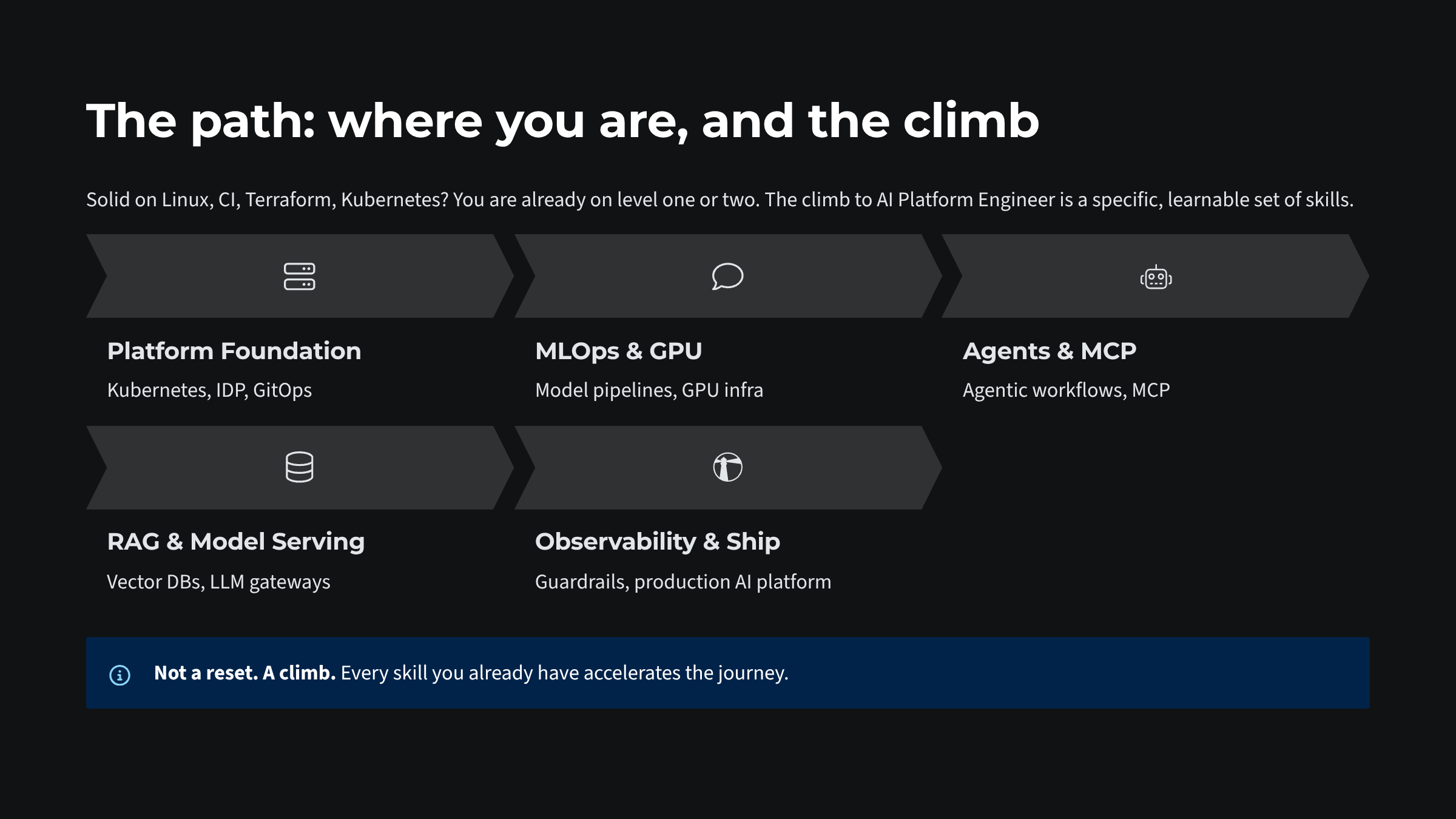
The climb from here to AI Platform Engineer is not some mysterious reset. It is a specific, learnable set of skills, stacked in order. Platform foundation first. Then MLOps and GPU infrastructure. Then AI agents and the protocols that connect them. Then RAG, so your AI can answer from your own data. Then model serving in production. Then observability, so you can actually see what your AI is doing. It is a staircase, not a cliff, and every single step is something you are well positioned to learn, because you have done the hard version of this before.
A quick word on production
One honest note before we wrap up, because I care about you doing this right and not just fast. When you start letting AI take actions on your platform, keep a human in the loop for anything that writes or changes state. Let the AI suggest, diagnose, and draft. You approve. That one habit is the difference between a tool that makes you stronger and a tool that creates a mess at 3am. Production-real means real guardrails, not blind automation.
Where to start
If you want to walk this path with the climb laid out for you, I built two bootcamps that stack perfectly. The Platform Engineering Bootcamp takes you through building a real internal developer platform end to end, which is the foundation level done properly. The AI Platform Engineering Bootcamp takes you all the way to a production AI platform: the agents, the RAG, the model serving, and the observability.
And if you are not sure which level you are standing on, start with the Start Here learning path. It maps the whole journey from the Linux command line to AI Platform Engineer and recommends your starting point after six quick questions.
Let me leave you with the one idea that matters most. AI is not the thing that replaces you. The engineer who knows how to run the AI is the one who replaces the engineer who does not. Now you know which one to become, and you know the exact path to get there.
Ready to find your starting point? Head over to Start Here. ↓